dubai is expensive, right?

After ten years, it was finally time to revisit a destination that changes from day to day. Everything there is presented in superlatives, and most things seem unimaginable for ordinary people. But is that really the case?

We’re going to Dubai!

Most people visit Dubai because of its luxury, its reputation as a city of opportunity, and the belief that everything happens there. Many imagine that you can simply go there, land a million-dollar deal, and earn a fortune without working too hard.

But my trip to Dubai had a different purpose. It was more about reconnecting with family and taking a break from daily routines and work. We explored a lot, averaging 20,000 steps a day, cycling, taking the metro, driving, and using Uber.

It’s fascinating how all of this exists in the middle of the desert—how it functions, how it stands. The skyscrapers have shapes that look like something a two-year-old might draw—but they actually build them. It feels like physics and engineering work differently there.

One of the most common questions I got was, “Dubai is expensive, right?” And I always answered: not really. Prices are similar to ours. Of course, there’s a wide price range—if you dine at a luxury location, you’ll pay accordingly. But isn’t it the same everywhere? A coffee at a small countryside café is not the same as a coffee at a high-end spot in the city.

But what struck me the most was something else. As we walked through Dubai Marina in the evening, surrounded by lights, lively terraces, and people strolling around, I started to focus on the people themselves. I noticed that most of them were Europeans, and many of them seemed… empty. There were a lot of lonely faces, lacking real joy and relaxation. Perhaps they had come to Dubai thinking they had finally “made it,” that they had escaped the worries of adult life—only to realize they were wrong. Or maybe I’m the one who’s wrong, I don’t know. But as I walked and observed, one thought kept coming to mind:

Glitz and hardship—two worlds of the same reality.

Another thing that fascinated me was the reality of the workers who keep this shiny world running—Pakistanis, Indians, Bangladeshis, Sri Lankans, Nepalis… They make up 90% of Dubai’s population and work for low wages, sharing rooms and sending their earnings back home to support their families. And yet, despite their struggles, they are always kind, smiling, and ready to help. Even when dealing with Europeans who often have a superior attitude, they remain calm, as if ego doesn’t exist for them. They repeat things patiently, never rolling their eyes or reacting aggressively—so different from what we’re used to.

There are many more thoughts running through my mind, but perhaps I’ll save them for another time, on another occasion.

Overall—Dubai is a city of contrasts. It’s worth visiting, as there’s something for everyone. It’s constantly changing, growing, demolishing, and rebuilding. If anything is possible anywhere, it’s possible there. And when you see their plans for the future and talk to the “locals,” you realize—everything is possible. At least in Dubai.

The art of working as a Photographer

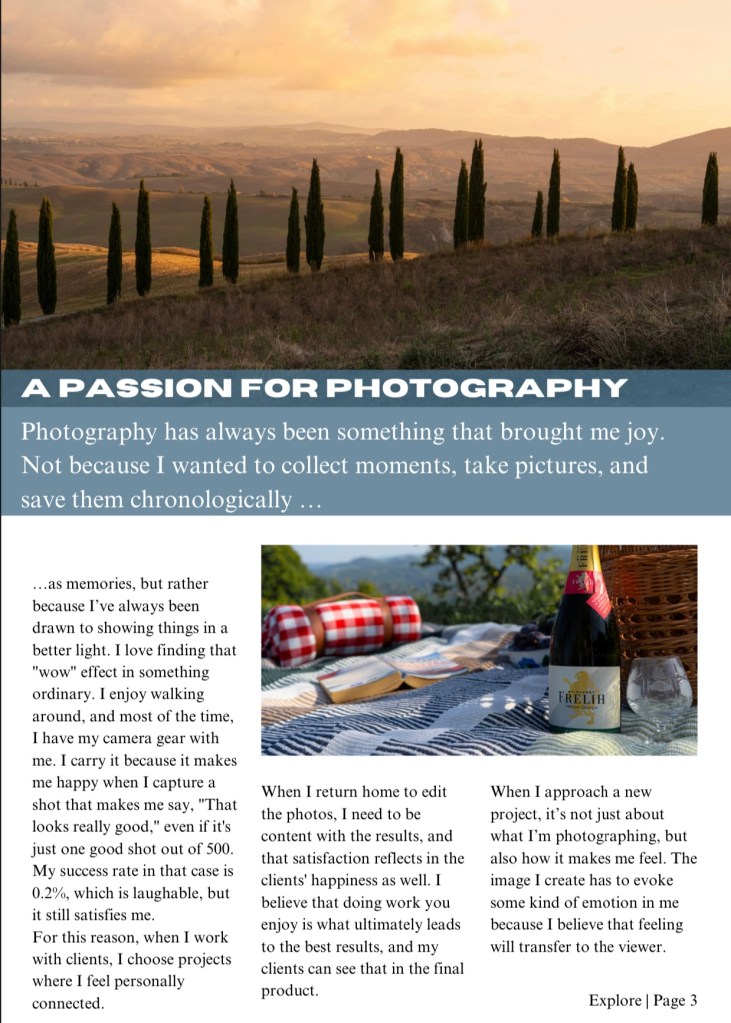
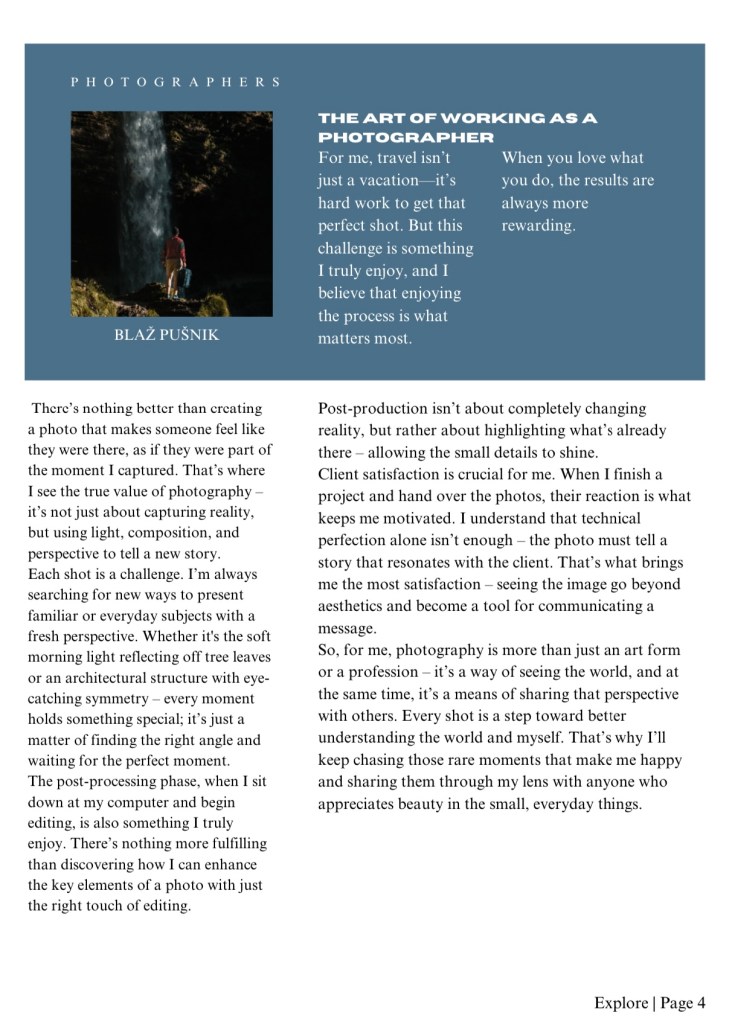
hotography has always been something that brought me joy. Not because I wanted to collect moments, take pictures, and save them chronologically as memories, but rather because I’ve always been drawn to showing things in a better light. I love finding that “wow” effect in something ordinary. I enjoy walking around, and most of the time, I have my camera gear with me. I carry it because it makes me happy when I capture a shot that makes me say, “That looks really good,” even if it’s just one good shot out of 500. My success rate in that case is 0.2%, which is laughable, but it still satisfies me.

For this reason, when I work with clients, I choose projects where I feel personally connected. When I return home to edit the photos, I need to be content with the results, and that satisfaction reflects in the clients’ happiness as well. I believe that doing work you enjoy is what ultimately leads to the best results, and my clients can see that in the final product.

When I approach a new project, it’s not just about what I’m photographing, but also how it makes me feel. The image I create has to evoke some kind of emotion in me because I believe that feeling will transfer to the viewer. There’s nothing better than creating a photo that makes someone feel like they were there, as if they were part of the moment I captured. That’s where I see the true value of photography – it’s not just about capturing reality, but using light, composition, and perspective to tell a new story.

Each shot is a challenge. I’m always searching for new ways to present familiar or everyday subjects with a fresh perspective. Whether it’s the soft morning light reflecting off tree leaves or an architectural structure with eye-catching symmetry – every moment holds something special; it’s just a matter of finding the right angle and waiting for the perfect moment.

The post-processing phase, when I sit down at my computer and begin editing, is also something I truly enjoy. There’s nothing more fulfilling than discovering how I can enhance the key elements of a photo with just the right touch of editing. Post-production isn’t about completely changing reality, but rather about highlighting what’s already there – allowing the small details to shine.

Client satisfaction is crucial for me. When I finish a project and hand over the photos, their reaction is what keeps me motivated. I understand that technical perfection alone isn’t enough – the photo must tell a story that resonates with the client. That’s what brings me the most satisfaction – seeing the image go beyond aesthetics and become a tool for communicating a message.

So, for me, photography is more than just an art form or a profession – it’s a way of seeing the world, and at the same time, it’s a means of sharing that perspective with others. Every shot is a step toward better understanding the world and myself. That’s why I’ll keep chasing those rare moments that make me happy and sharing them through my lens with anyone who appreciates beauty in the small, everyday things.

9-to-5 jobs

My view on the current situation regarding regular “Traditional” Jobs.

“In today’s world, traditional 9-to-5 jobs have become mentally and physically exhausting. Working year-round under constant pressure, with only a few days of vacation, leaves little time for personal health or travel.

As a result, many are leaving regular employment behind, choosing instead to make a living as freelancers. Jobs as we knew them are no longer attractive to the average person, as people now prioritize their mental well-being. The shift in work culture has also extended tourist seasons, as people, especially younger generations, lead lives that are much different from before. With an increasing pace of life and rising pressures, this trend continues to grow.

As more people recognize the toll that rigid work schedules take on their well-being, they are seeking greater flexibility and freedom in their lives. Freelancing offers the opportunity to set one’s own hours, pursue passions, and maintain a healthier work-life balance. This shift is reshaping industries, with businesses adapting to cater to a new type of worker-one who values autonomy and personal time over traditional career paths. The extension of tourist seasons reflects this broader change, as more people now have the ability to travel outside of conventional vacation periods.

The increasing focus on personal well-being is not just a trend but a lifestyle shift. People are investing more time in fitness, mental health, and experiences rather than being tied to a desk.

This changing dynamic highlights the growing desire for a life that isn’t solely defined by work, but by personal fulfillment and exploration. As the workforce continues to evolve, so too will our understanding of success, with more emphasis on living life to the fullest”.